An effective Oil Spill Contingency Plan goes beyond regulatory documentation. It establishes a practical framework for managing spill risks, coordinating response activities and ensuring that people, procedures and resources can work together when an incident occurs.

An oil spill can occur in many operational environments, including seaports, terminals, shipyards, offshore facilities and industrial sites. Even facilities that do not routinely handle petroleum products may face spill risks arising from visiting vessels, machinery, fuel systems, accidents or third-party activities.
When a spill occurs, the quality of the response depends on more than the availability of equipment. Personnel need to recognise the incident, understand their responsibilities, notify the appropriate parties, assess the situation and implement suitable response measures. These actions must take place within a coordinated framework, often under considerable time pressure.
An Oil Spill Contingency Plan (OSCP) provides that framework. However, a plan that exists only as a document may offer limited practical value if its procedures are unclear, its contact information is outdated or its response arrangements depend on resources that cannot be mobilised when required.
At PIER Consultancy Pte Ltd, our approach to oil spill contingency planning is built around a fundamental principle: the plan must reflect the facility’s actual risks, operating environment, available resources and response responsibilities.
Our objective is to help organisations establish a structured, realistic and operationally relevant basis for responding to oil spill incidents, while identifying preparedness gaps that need to be addressed.
Every oil spill contingency planning assignment begins with understanding the facility and its operations.
No two ports or industrial facilities are identical. Their physical layouts, vessel activities, environmental surroundings, operational interfaces and emergency arrangements differ. Consequently, an OSCP should not simply be copied from another facility and adapted by changing the names and contact details.
PIER begins by working with the client to understand the facility’s purpose, operating activities, geographical coverage and intended response capability.
This initial stage typically involves discussions with facility management and relevant personnel from operations, safety, environmental management, security and emergency response. Available documents are reviewed to establish a baseline understanding of the site and its existing arrangements.
Depending on the assignment, information may include:
Facility layout plans, berth arrangements and access routes.
Vessel movements, cargo activities and relevant operational interfaces.
Existing emergency procedures, incident records and contact directories.
Environmental information and nearby areas that may require protection.
Existing response personnel, equipment and external support arrangements.
Applicable regulatory requirements and relevant authority guidance.
The information review also identifies missing data and assumptions that require clarification.
For example, a port that does not handle petroleum cargo may reasonably consider its exposure different from that of an oil terminal. Nevertheless, potential spill sources associated with visiting vessels, machinery, fuel systems or other activities still need to be considered.
Understanding these operational realities provides the foundation for a plan that is proportionate to the facility’s actual circumstances.
Document reviews alone cannot always reveal how a facility operates in practice. A site assessment allows the planning team to examine the physical environment, understand operational interfaces and discuss potential response challenges with the people who know the facility best.
Where included in the agreed scope, PIER conducts site visits and consultations to examine relevant areas such as berths, vessel approaches, access routes, drainage outlets where applicable, adjacent shorelines and potential pathways through which spilled oil could spread.
The assessment considers credible spill sources and scenarios rather than assuming that every facility faces the same level or type of risk.
These scenarios may include accidental releases from visiting vessels, incidents involving vessel machinery or fuel systems, third-party activities and other sources identified during the assessment.
For each relevant scenario, the planning process considers factors such as:
The possible source and nature of the release.
The location and operational circumstances in which it could occur.
Potential consequences for port operations and the surrounding environment.
Areas or resources that may require protection.
The initial actions needed to assess and manage the incident.
The response resources and external assistance that may be required.
Environmental conditions are also important. Where suitable information is available, historical tide and wind data can contribute to the understanding of local conditions and support response planning.
The depth of analysis depends on the project requirements and available information. Specialist environmental surveys, detailed hydrodynamic studies or oil spill trajectory modelling may require separate work beyond a standard contingency planning assignment.
The outcome of this stage is a risk assessment and planning basis that identifies credible scenarios, response priorities, information gaps and important assumptions.
This enables the OSCP to be developed around identified risks rather than generic descriptions of possible emergencies.
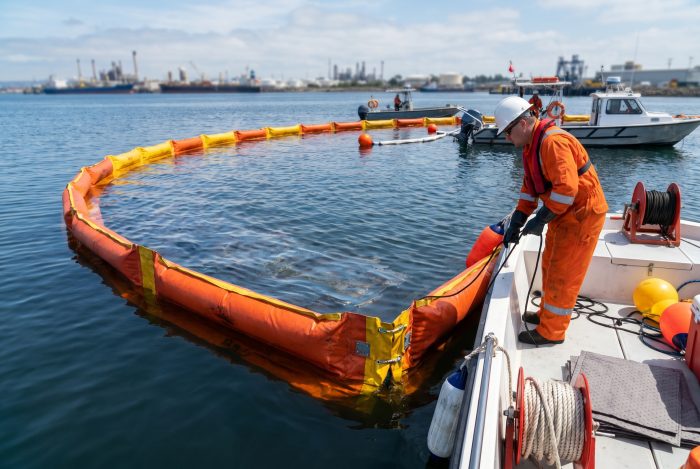
During an oil spill, uncertainty over who should act, who should be notified and who has authority to make decisions can delay an effective response.
A practical OSCP therefore needs to establish clear responsibilities and communication arrangements.
PIER develops the response framework around the facility’s operating structure and the applicable regulatory and emergency management arrangements. The plan should explain how an incident is recognised, assessed, reported and escalated, and how the relevant personnel and external organisations are brought into the response.
Depending on the facility and applicable requirements, the plan may address:
Initial incident recognition and reporting.
Immediate safety precautions and initial assessment.
Incident activation levels and escalation criteria.
Internal notification and communication procedures.
Notifications to relevant authorities and response organisations.
Incident management roles and responsibilities.
Coordination between facility personnel and external responders.
Incident records, reporting and information management.
The precise procedures must reflect the applicable requirements and the facility’s actual operating arrangements.
Contact directories and notification flowcharts are particularly important supporting elements. They should make it easy for personnel to identify whom to contact, what information to communicate and what actions are expected next.
Where external agencies or contractors have defined responsibilities, those interfaces should be clearly documented and confirmed with the relevant parties.
The objective is to reduce ambiguity and provide personnel with a practical sequence of actions to follow during an incident.
A contingency plan must describe response arrangements that can be implemented in practice.
This requires careful consideration of the resources available to the facility, the assistance that can be obtained externally and the time needed to mobilise that assistance.
PIER examines the proposed response arrangements against the spill scenarios identified during the risk assessment. Depending on the agreed scope, the OSCP may cover initial assessment, source control where feasible, containment and recovery options, protection priorities, waste handling, personnel safety, demobilisation and incident documentation.
Not every response technique will be appropriate for every spill. The selected approach must consider the circumstances of the incident, environmental conditions, safety requirements, available equipment and applicable instructions from the responsible authorities.
Equally important is an honest assessment of resource availability.
A facility may intend to rely on an external oil spill response contractor rather than maintain all response equipment and specialist personnel itself. Such an arrangement may form part of the planning solution, but it should not be treated as confirmed capability merely because a contractor has been identified.
The planning process should establish whether the proposed resources are genuinely available and suitable for the facility’s needs. Relevant considerations include:
The types and quantities of equipment available.
The location and condition of the equipment.
The availability of trained personnel.
Expected mobilisation and transportation arrangements.
Access to the facility and deployment locations.
Communications, responsibilities and service arrangements.
Written agreements or other evidence supporting the proposed commitment.
Where information is incomplete or arrangements have not been confirmed, these matters should be recorded as outstanding requirements or preparedness gaps.
This distinction is essential. Preparing an OSCP does not, by itself, establish that a facility has the operational capability to respond to a spill. Actual readiness depends on the implementation of the plan, the availability of resources and the ability of the people involved to perform their assigned roles.
An OSCP must be developed with reference to the regulatory framework applicable to the facility and its location.
This may include the applicable National Oil Spill Contingency Plan, relevant local guidance and circulars in force at the time of preparation, and any additional directions relevant to the facility.
The precise requirements must be established for the particular project. Requirements should not be assumed to be identical across countries, facility types or regulatory classifications.
PIER’s approach is to identify the relevant requirements at the outset and use them as a basis for structuring the plan, defining response arrangements and identifying any areas where further clarification is necessary.
Where a facility is seeking to establish or demonstrate a particular level of oil spill response capability, that objective must also be assessed against the applicable requirements.
For example, a facility that has no dedicated response equipment or trained response personnel may need to establish suitable external support arrangements or address other resource requirements before its intended capability can be demonstrated.
The plan should clearly identify what is already in place, what remains to be confirmed and what actions may be necessary to close the gaps.
PIER can prepare the OSCP and provide technical support within the agreed scope. However, regulatory approval remains the responsibility of the competent authority. The final outcome depends on the applicable requirements, the submitted information and the authority’s assessment.
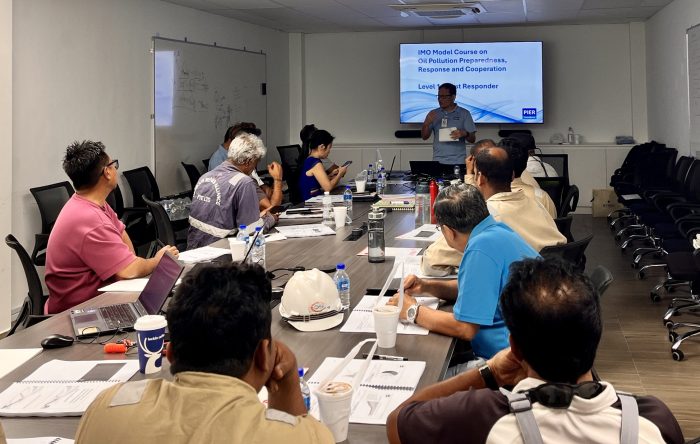
Once the planning basis and response arrangements have been established, PIER develops the facility-specific OSCP.
The document is structured to provide a clear framework for preparedness, notification, incident management and response. It should be sufficiently comprehensive to address the agreed requirements while remaining accessible to the people who may need to use it.
Depending on the facility and scope, the plan may include:
Purpose, scope, geographical coverage and planning assumptions.
Facility profile and credible oil spill scenarios.
Risk assessment and response priorities.
Roles, responsibilities and incident management arrangements.
Activation, notification and escalation procedures.
Response strategies and operational checklists.
Resource inventories and external mobilisation arrangements.
Site plans, maps and relevant environmental information.
Emergency contact directories and notification flowcharts.
Incident reporting forms, records and document control procedures.
Supporting annexes are particularly valuable because they allow users to locate essential information without searching through the entire document.
For example, a notification checklist can help the initial responder communicate the key facts about an incident. A resource list can help the response coordinator identify the equipment and assistance that may be required. A site map can help personnel understand access routes and relevant operational locations.
The usefulness of these supporting materials depends on the accuracy of the information supplied and verified by the client.
For this reason, document preparation should be accompanied by appropriate consultation, information checks and review by the people responsible for implementing the plan.
A draft OSCP should be reviewed before it is finalised.
PIER’s proposed approach includes submitting the draft to the client and relevant stakeholders for consolidated comments, followed by a review meeting where included in the agreed scope.
This stage allows the planning team to clarify operational details, confirm responsibilities and address inconsistencies or omissions identified during review.
The review should consider whether the procedures reflect the facility’s actual operations, whether proposed resources and external arrangements have been confirmed, and whether personnel can understand the actions assigned to them.
The final plan is then updated to incorporate the agreed comments and issued in the agreed formats.
Where the plan is intended for submission to a regulatory authority, the final document should be prepared to support that process. Any subsequent authority comments must be addressed according to the agreed scope of work, with additional studies or materially expanded requirements handled separately where necessary.
Importantly, finalising the document is not the end of the preparedness process. The organisation must still implement the arrangements described in the plan and keep relevant information current.
Changes in operations, personnel, equipment, contact details, external support arrangements or regulatory requirements may necessitate a review and revision of the OSCP.
A well-prepared OSCP establishes the foundation for an effective response, but the next question is whether the organisation can execute it.
Do personnel understand their roles? Can the required notifications be made promptly? Are decision-making responsibilities clear? Can external resources be mobilised as expected? Do the procedures remain practical when several activities need to be coordinated simultaneously?
These questions can be explored through suitable exercises and drills.
Depending on the facility’s requirements and the scope of a separate engagement, a tabletop exercise can bring relevant personnel together to discuss their actions in a simulated spill scenario. A more operational drill may test selected notification procedures, equipment arrangements or response activities.
Observations from these activities can identify gaps that are not always apparent during document preparation. The findings can then inform improvements to the plan, procedures, training and resource arrangements.
At PIER, this reflects a broader approach to emergency preparedness:
PLAN → TEST → IDENTIFY → IMPROVE → RETEST
Develop the plan around realistic risks. Test the arrangements through suitable exercises. Identify weaknesses in communication, coordination, decision-making and resources. Implement improvements, then test again to determine whether those improvements are effective.
Exercise design, delivery, equipment deployment and formal evaluation are separate activities that should be scoped according to the organisation’s needs. They should not be assumed to be included automatically in every OSCP assignment.
Nevertheless, integrating contingency planning with a longer-term programme of testing and improvement helps organisations move beyond having a document towards building more reliable response arrangements.
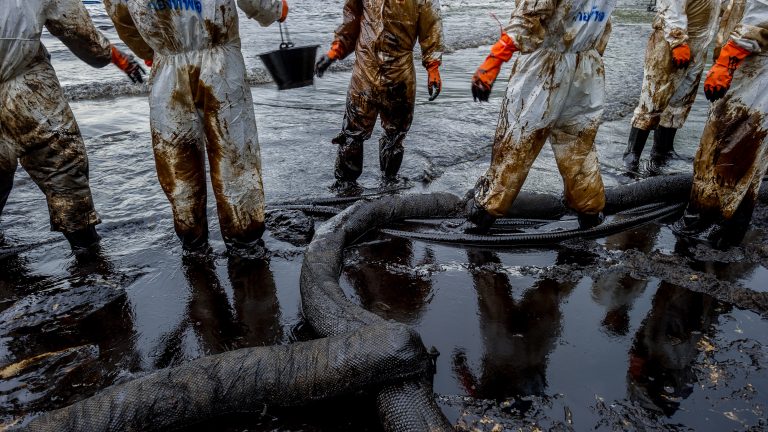
Successful contingency planning depends on collaboration between the consultant, facility management, operational personnel and other relevant stakeholders.
PIER provides the planning methodology, risk assessment and technical documentation within the agreed scope. The client and facility representatives provide the operational information, facilitate access, verify relevant details and make decisions concerning resources and implementation.
Where external response contractors are involved, their commitments and capabilities must also be established and documented appropriately.
This collaborative process helps ensure that the OSCP is grounded in the facility’s actual circumstances rather than relying solely on assumptions made during document preparation.
It also helps identify decisions that must be made by the facility or its management, including the provision of resources, confirmation of external support and implementation of outstanding preparedness actions.
The result should be a plan that is relevant to the organisation, clear about responsibilities and realistic about the capabilities on which it depends.
Oil spill contingency planning is not simply a documentation exercise. It requires an understanding of operational risks, a clear response structure, realistic procedures, verified resource arrangements and alignment with applicable regulatory requirements.
PIER Consultancy approaches OSCP development as a structured process that begins with understanding the facility, progresses through site assessment and risk analysis, and results in a practical, facility-specific plan for review and implementation.
Just as importantly, the process helps identify gaps between the response arrangements an organisation intends to have and those it can actually demonstrate.
For ports, terminals and other facilities seeking to strengthen their oil spill preparedness, this is an important distinction. A plan should provide more than a description of what ought to happen. It should establish a credible framework for how the organisation intends to respond, who will be responsible and what resources will be needed.
At PIER Consultancy, we believe effective emergency preparedness combines sound planning with practical implementation, regular testing and continuous improvement.
A plan is only as good as your ability to execute it.
If your organisation needs to develop a new Oil Spill Contingency Plan, review existing arrangements or assess gaps in emergency preparedness, PIER Consultancy can help you identify the next steps towards a more practical and coordinated response capability.
We help organisations strengthen their emergency preparedness through tailored contingency plans, realistic exercises and practical response solutions — helping teams know what to do, when to act and how to respond effectively when it matters most.